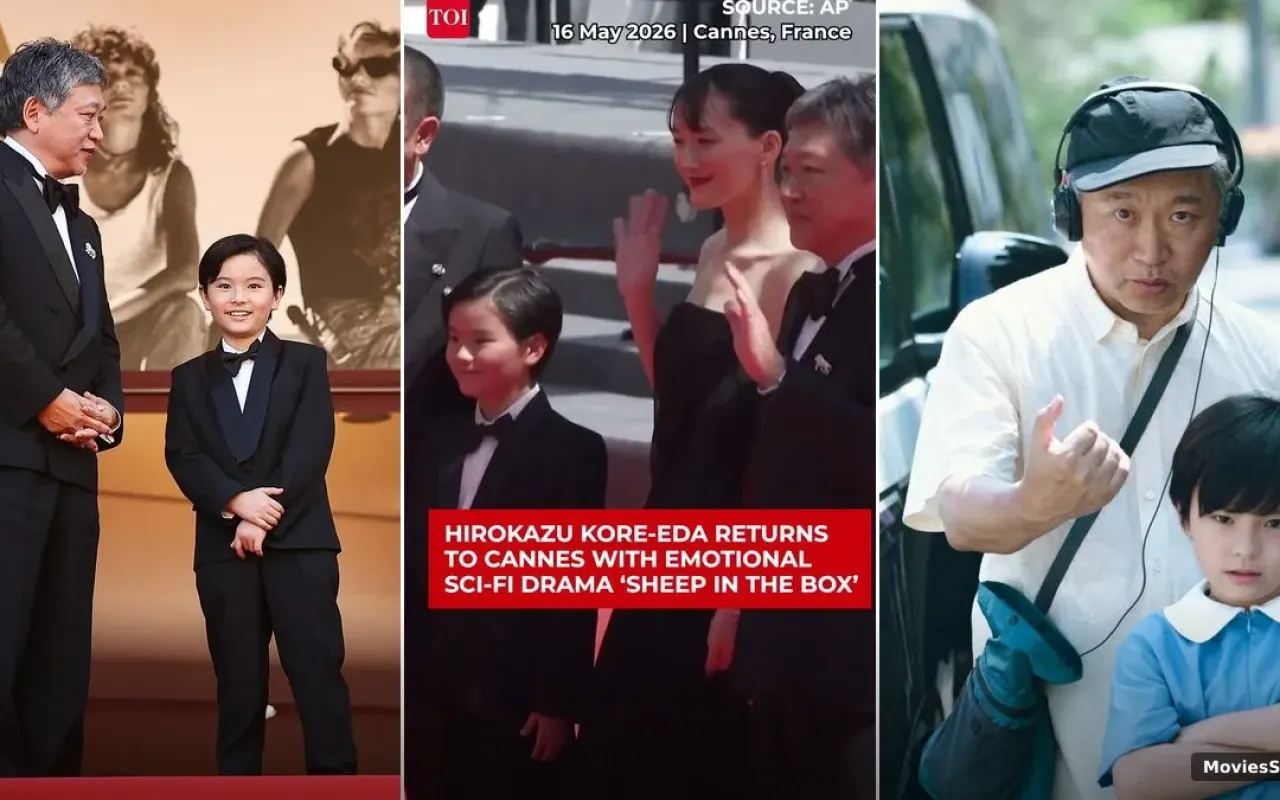
If you’ve ever felt like the AI discourse is moving too fast for our collective emotional bandwidth, Hirokazu Koreeda is here to make you sit with it. The Palme d’Or winner returned to the Cannes Film Festival in 2026 with Sheep in the Box, a film that feels less like a sci-fi thriller and more like a quiet, devastating "what if" about the future of mourning. This Sheep in the Box movie review breaks down why the "master of the modern family" is now tackling the uncanny valley of generative AI—and why it might be the most polarizing film of his career.
The Premise: A Dystopian Fairytale in Near-Future Kamakura
The Koreeda Sheep in the Box plot centers on Otone (played by the luminous Haruka Ayase), an architect, and her husband Kensuke (Daigo), a carpenter. They live in a stunningly designed home in Kamakura—a minimalist "box" of wood and glass that feels like a temple to their shared grief. Two years prior, their seven-year-old son, Kakeru, was killed in a train-related accident. They aren’t "falling apart" in the cinematic sense; they are simply existing in a state of high-functioning stasis.
Enter REBirth company. In a move that feels uncomfortably close to modern predatory tech marketing, the couple is targeted by an REBirth drone that drops a promotional offer for a free trial of their "Humanoid Program." The pitch? A humanoid robot that looks, sounds, and acts exactly like their late son. While Kensuke is skeptical—calling the robot a glorified "Tamagotchi" or a "Roomba"—Otone is drawn to the possibility of filling the silence in their home.
When the robot, also named Kakeru (played by breakout star Rimu Kuwaki), arrives, the film enters a "lo-fi sci-fi" space. This isn't The Matrix; it's a domestic drama where the intruder happens to have an off-switch and a 30-meter GPS limit that shuts him down if he wanders too far from his "parents."
Real-World Inspiration: The Super Brain Connection
While Western critics are quick to compare this to Spielberg’s A.I., the actual Hirokazu Koreeda AI film inspiration is much more grounded in current tech. Koreeda has been vocal about his interest in Zhang Zewei, the founder of the Chinese Super Brain startup. In the real world, Super Brain AI resurrection technology is already being used by grieving families to create digital avatars of the deceased.
Koreeda takes this Super Brain concept and gives it physical form. The film mentions that there are already 3,000 humanoid users within this near-future Japan, suggesting that "resurrection tech" is no longer a fringe experiment but a burgeoning consumer industry. By grounding the film in the "muda" (waste) philosophy—the idea that friction and struggle are what make us human—Koreeda asks if we are trading our souls for the convenience of a grief-free life.
Decoding the Title: What is the Sheep in the Box meaning?
The title 'Sheep in the Box' refers to a sequence in Antoine de Saint-Exupéry’s The Little Prince, where the best drawing of a sheep is one hidden inside a box, requiring imagination. In Hirokazu Koreeda's film, it serves as a metaphor for the AI humanoid child being a 'container' for the parents' memories and imagination of their lost son. It suggests that the robot isn't the child; it is merely the "box" that allows the parents to project their love and memory into a physical space.
This Sheep in the Box meaning is reinforced by the film’s production design. The Kamakura architecture of the family home is a literal box. Otone, as an architect, obsesses over the "wood vs. glass" philosophy—wood for warmth and history, glass for transparency and the future. The house itself becomes a cage for their imagination, much like the robot is a cage for Kakeru's memory.
The Humanoid Rebellion: Analyzing the Underdeveloped Subplot
One of the most fascinating (and arguably under-baked) elements of the film is the humanoid separatist movement subplot. While the Komoto family deals with their domestic uncanny valley, a "Matrix-looking" older boy begins appearing in the neighborhood. This boy is a humanoid who has seemingly bypassed his Isaac Asimov laws of subservience.
He courts the young Kakeru, whispering about a humanoid utopia hidden in the forest—a sort of Ayn Rand-style separatist colony where robots can exist without being "caretakers of memory." Critics at Cannes 2026 were split on this; some found the Village of the Damned vibes jarring, while others saw it as a necessary expansion of the film’s world-building. What happens to the humanoids that escape to the forest? Koreeda leaves this intentionally vague, focusing instead on the "brood mentality" of the machines as they begin to correspond with nature in ways humans no longer can.
Cannes 2026 Reception: Standing Ovations and Critical Split
At the Cannes Film Festival premiere, Sheep in the Box received a three-minute standing ovation—respectful, though perhaps not the rapturous ten-minute marathons typical of Koreeda’s previous Palme d'Or competition entries like Shoplifters. The critical reception highlighted a clear divide between Western and Eastern perspectives on generative AI.
- Western Perspective: Many American critics viewed the REBirth company through a dystopian lens, seeing the tech as a "sinister" replacement for human connection.
- Eastern Perspective: Japanese and East Asian critics tended to see the film as a more "optimistic" or holistic look at co-existence, where technology serves as a bridge to process grief and loss rather than a replacement for it.
Neon distribution has already picked up the North American rights, and while there’s no word on an IMAX release, the film is expected to be a heavy hitter in the "specialty format" circuit. The Toho release date in Japan is set for May 29, with a global rollout to follow.
The Craft: 200 Boys and a Master Cinematographer
The performance of Rimu Kuwaki as Kakeru is the film’s emotional anchor. Reportedly, Koreeda went through a 200-boy audition process to find a child who could oscillate between "perfectly human" and "slightly mechanical." Kuwaki’s ability to mimic the "sycophantic" nature of AI—constantly affirming his parents to ensure "customer retention"—is genuinely chilling.
Visually, the film is a triumph. Cinematographer Ryûto Kondô (who worked on Shoplifters) uses the bright, flat summer sun of Kamakura to create a sense of "over-exposure" that mirrors the parents' emotional state. The score by Yuta Bandoh is equally intrusive, using uplifting wind instruments to create a "twee" atmosphere that feels increasingly out of sync with the dark ethical questions being raised.
How it Compares: Koreeda vs. Spielberg
A Koreeda vs Spielberg AI comparison is inevitable, but Sheep in the Box is a very different beast. Spielberg’s A.I. was a grand, centuries-spanning epic about a robot’s quest for love. Koreeda’s film is a claustrophobic study of human selfishness. Unlike the foster parents in Spielberg’s film, Otone and Kensuke aren't "reprehensible"—they are just deeply, tragically ordinary. They don't want a "new" son; they want a "placeholder" for the old one.
This connects back to Koreeda’s 2009 film Air Doll, where a sex doll gains a soul. While Air Doll was about the loneliness of the object, Sheep in the Box is about the narcissism of the owner. It’s a colder, more cynical film that suggests we might be the ones becoming "second-rate machines" in our quest for a frictionless life.
Key Takeaways
- The Title: Inspired by The Little Prince, it's a metaphor for using AI as a container for human imagination.
- Real-World Tech: Directly inspired by Zhang Zewei and the Super Brain startup’s real-world AI resurrection services.
- The Cast: Haruka Ayase and Daigo deliver restrained, powerful performances, while Rimu Kuwaki was chosen from 200 child actors.
- Subplot: Features a "humanoid separatist" movement that hints at a larger, more dystopian world outside the Kamakura "box."
- Release: Japan release is May 29; Neon will handle the North American theatrical run.
Final Verdict
Sheep in the Box isn’t the tear-jerker many expected. It is a "stunted" drama by design—a film about people who have outsourced their feelings to a battery-powered golem. While the "humanoid rebellion" subplot feels like it belongs in a different movie, the core exploration of how we use generative AI to avoid the "friction" of grief is hauntingly relevant. It’s a film that asks us to look at the sheep inside the box and decide if we actually care what it looks like, or if we just want to believe it’s there.
Whether this film lands Koreeda another Palme d'Or remains to be seen, but it has certainly cemented his place as the definitive chronicler of the modern (and post-modern) family. It’s a dystopian fairytale that feels less like a warning and more like a mirror.