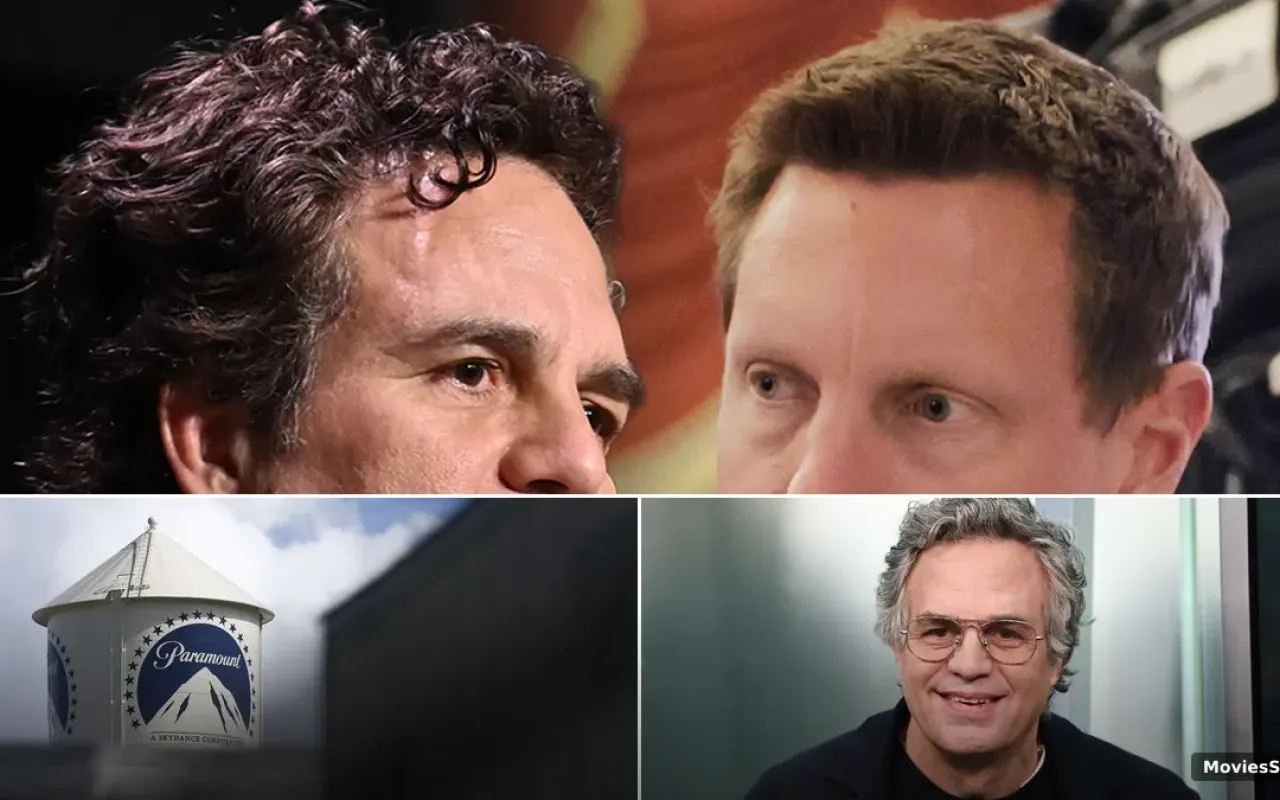
The smartest person in your group chat just found a new hill to die on, and this time, it involves the Hulk, a $110 billion hostile takeover, and a "banned" list that sounds like something straight out of a 1950s spy thriller. Real talk: Mark Ruffalo is currently leading a high-stakes rebellion against the proposed Mark Ruffalo Paramount Warner Bros merger, and he’s doing it with the kind of "nothing to lose" energy that has Hollywood executives sweating through their Brioni suits.
At the center of this storm is the Paramount Skydance WBD acquisition, a deal that would effectively redraw the map of American media. Ruffalo isn't just tweeting his concerns; he’s claiming that his opposition to the merger has landed him on a Hollywood banned actors list. According to Ruffalo, industry insiders have warned him that the architects of the deal—Oracle billionaire Larry Ellison and his son, Skydance CEO David Ellison—are "vindictive motherf***ers" who don't forget a slight. Here is why the Block the Merger coalition is sounding the alarm and what this massive consolidation means for your Netflix bill, your job, and the future of the news.
The $110 Billion Bet: Why Mark Ruffalo is Opposing the Paramount Warner Bros Merger
To understand why a four-time Oscar nominee is risking his standing with the biggest gatekeepers in the industry, you have to look at the math. The Mark Ruffalo Paramount Warner Bros merger is a behemoth that would consolidate two of the most iconic "Big Five" studios into a single, monopoly power.
Why is Mark Ruffalo opposing the Paramount Warner Bros merger? Ruffalo opposes the $110 billion merger because it would reduce the number of major film studios to four, leading to job losses, higher consumer costs, and a threat to the editorial independence of news organizations like CNN and CBS. He argues that media consolidation of this scale creates a "degradation of journalism" and kills creative competition.
The deal itself is a financial labyrinth. After Netflix withdrew its $82.7 billion bid in February 2026, David Ellison’s Skydance moved in with a massive $110 billion offer. While the deal carries an equity value of $81 billion, it also addresses the elephant in the room: Warner Bros. Discovery’s staggering $40+ billion debt load. For the Ellisons, it’s a hostile takeover of the cultural zeitgeist. For the Writers Guild of America and the creative community sustainability movement, it’s a nightmare scenario of "vertical integration risks" that could lead to thousands of layoffs, mirroring the aftermath of the Disney-Fox merger.
The New Blacklist: Hollywood Blacklisting History vs. Modern Retribution
When Ruffalo says he is "already on a list," he is tapping into a dark vein of Hollywood blacklisting history. We aren't in the McCarthy era anymore, but the Democracy Defenders Fund and Ruffalo’s attorney, Norm Eisen, argue that the threat of retribution is a modern form of censorship. Ruffalo noted on the I’ve Had It podcast that while A-listers like himself have the financial cushion to speak out, mid-tier actors and production staff are terrified.
The Hollywood banned actors list might not be a physical document pinned to a bulletin board, but in an industry controlled by what Ruffalo calls "oligopolistic entities," a lack of invitations to auditions can be just as effective. This echoes the 1947 Committee for the First Amendment, where stars like Humphrey Bogart stood up against industry suppression. Today, the Block the Merger coalition has gathered over 5,000 signatures, but Ruffalo points out the most telling part isn't who signed—it’s who was too afraid to put their name down.
Antitrust War: The Legal Fight to Block the Merger
While the federal government often "rubber stamps" these deals, a coalition of State Attorneys General is becoming the last line of defense. Taking a page from the Clayton Antitrust Act and the Sherman Antitrust Act, these officials are investigating whether the deal violates the Hart-Scott-Rodino Act, which requires large companies to notify the Federal Trade Commission (FTC) and DOJ before merging.
- The Tegna Precedent: A group of 13 State Attorneys General previously successfully blocked the Tegna-Nexstar deal by focusing on local news impacts. They are looking to repeat that strategy here.
- Subpoena Power: Subpoenas have already been issued in New York and California to examine SEC filings and internal communications regarding the David Ellison Warner Bros Discovery negotiations.
- Preliminary Injunction: Legal experts suggest that if Lina Khan's FTC doesn't move fast enough, state-led lawsuits could seek a preliminary injunction to halt the merger before the Q3 2026 closing date.
The wild part? A state-level block can sometimes be more effective than a federal one, as it forces companies to fight multiple battles in different jurisdictions simultaneously.
The Death of Variety: What Happens to CNN and CBS?
The most chilling aspect of the Paramount Skydance WBD acquisition is the potential loss of editorial independence. If the deal goes through, the Ellison family would essentially control both CBS News and CNN. Ruffalo highlighted a recent 60 Minutes interview with Benjamin Netanyahu as a precursor of what’s to come, suggesting that news coverage is already shifting to accommodate the political and business interests of the Ellison Oracle political connections.
In a world where only four major studios remain—Disney, Universal, Sony, and the new Paramount-WBD entity—the "Big 4" landscape becomes a creative desert. When competition dies, prices go up. Economists warn that consumer harm in the streaming era isn't just about the monthly subscription fee; it’s about the "take it or leave it" power these giants have over what stories get told and which ones get buried in the hostile takeover of the archives.
The "Big 4" Studio Landscape Post-Merger
- Disney: The franchise king (Marvel, Star Wars, Pixar).
- Universal (Comcast): The blockbuster rival (Oppenheimer, Jurassic Park).
- Sony: The last "independent" major (Spider-Man, PlayStation IP).
- The "New" Paramount-WBD: A massive conglomerate owning HBO, CNN, CBS, Warner Bros., and Paramount Pictures.
Key Takeaways: The Mark Ruffalo vs. Paramount Battle
- The "List" is Real (Spiritually): Mark Ruffalo believes he and other critics are being blacklisted by the Ellisons for opposing the Mark Ruffalo Paramount Warner Bros merger.
- Massive Consolidation: The $110 billion deal would merge Paramount Global and Warner Bros. Discovery, leaving only four major studios in Hollywood.
- Job Loss Fears: Industry experts predict massive layoffs, similar to the 2019 Disney-Fox merger, as redundant departments are slashed for "synergy."
- News at Risk: Placing CNN and CBS under the same ownership raises massive red flags regarding editorial independence and media consolidation.
- Legal Hurdles: A Hollywood antitrust investigation led by State Attorneys General is the primary obstacle to the deal closing in 2026.
The Future of the Block the Merger Campaign
So, where do we go from here? The Block the Merger coalition isn't backing down. Ruffalo and attorney Norm Eisen are continuing to push for transparency in the SEC filings and are calling for a modern-day equivalent of the Paramount Decree of 1948—the landmark ruling that originally broke up the studio monopolies.
The catch is that the federal government’s appetite for antitrust enforcement can change with the political wind. However, as Ruffalo puts it, "courage is contagious." Whether this merger creates a new era of creative community sustainability or leads to the "death of variety" depends on whether the public—and the regulators—are as fearless as the man who plays the Hulk. If the Hollywood antitrust investigation gains enough steam, we might just see this $110 billion deal crumble before it can rewrite the rules of the game. For now, the industry is watching, waiting, and checking their names on the list.