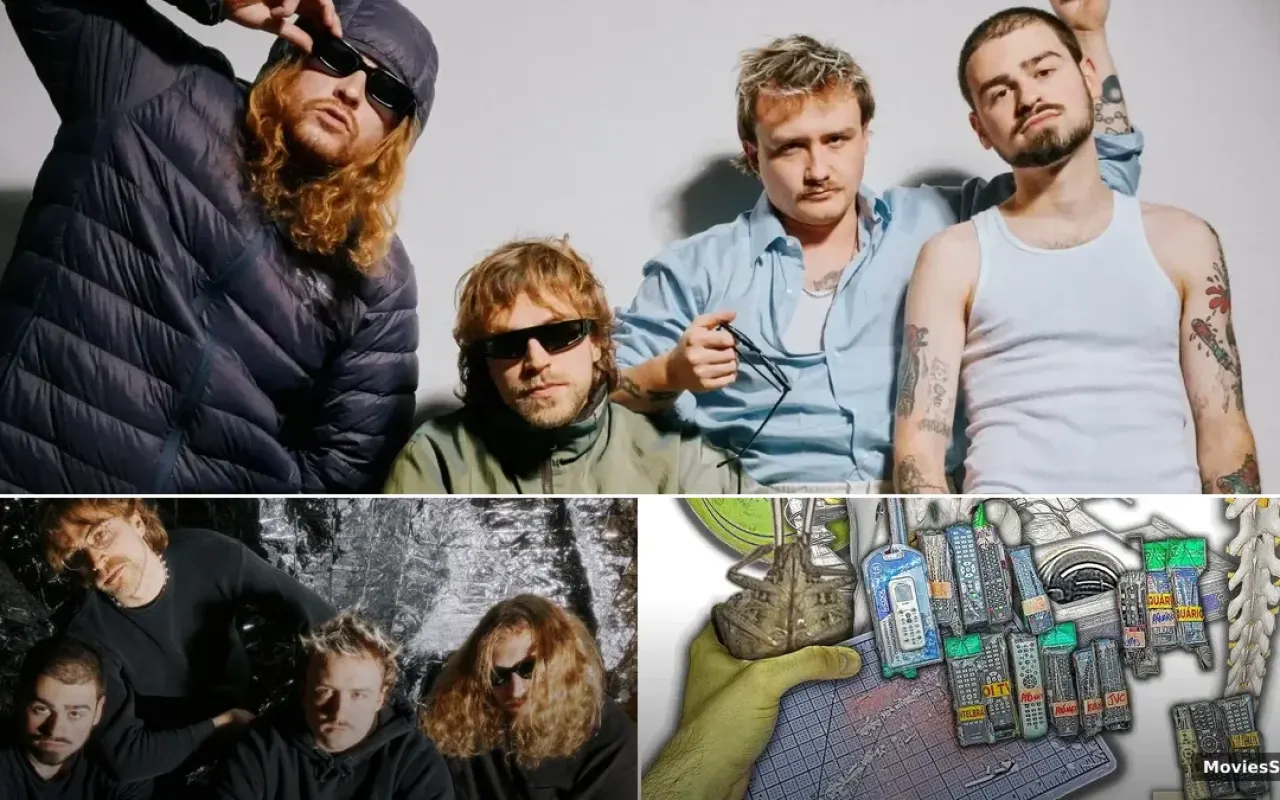
On May 1, 2026, the Brooklyn-based digital hardcore outfit Lip Critic released their sophomore effort, Theft World, via Partisan Records. It is a record born from a set of circumstances so bizarre they border on the apocryphal. In this Lip Critic Theft World review, we explore how a real-life encounter with an obsessed fan and a stolen identity forced the band to scrap an entire album’s worth of material to create a masterpiece of modern dread. This isn't just a collection of songs; it is a "media tiramisu" of surveillance, gambling metaphors, and the crushing weight of the attention economy.
What is the story behind Lip Critic's Theft World?
Theft World was inspired by the real-life identity theft of frontman Bret Kaser. A devoted fan believed the band's debut album, Hex Dealer, contained a hidden scavenger hunt. After hacking Kaser's personal information and making hundreds of purchases, the fan met the band in a Five Nights At Freddy's hoodie to explain his 'victory.' This bizarre encounter led Lip Critic to scrap 20 nearly-finished songs and record Theft World as a concept album about obsession, surveillance, and modern theft.
The Scavenger Hunt That Sparked a Masterpiece: The Lore Timeline
The genesis of Theft World is inseparable from a sequence of events that began shortly after the release of their 2024 debut, Hex Dealer. As the band began work on their follow-up, a fan became convinced that Lip Critic had embedded a "4D chess-level" scavenger hunt within their Bandcamp discography. This individual didn't just look for clues; he hunted for Bret Kaser himself.
The timeline of this digital-age haunting is chilling. The fan successfully breached Kaser’s personal data, including his Social Security number and banking information. In a move Kaser described as a "malicious wink," the thief used the stolen credit card to purchase the band's entire digital catalog hundreds of times over. The saga culminated at a merch table where the fan appeared wearing a Five Nights At Freddy's hoodie and a surgical mask, reciting Kaser’s private data with a grin.
Rather than retreating, the band—comprising Kaser, Connor Kleitz, Danny Eberle, and Michael Sandvig—invited the thief to a 24-hour halal restaurant. They recorded the encounter, listening as he detailed the "rules" of the imaginary game he believed he had won. This interview, though currently unreleased, became the foundation for the album. The 15-20 songs the band had already completed were immediately shelved, deemed irrelevant in the face of this terrifyingly "real" manifestation of their own lyrical themes.
Sonic Architecture: Spectral Gating and the 'Media Tiramisu'
Musically, Theft World is an evolution of the experimental punk and noise rock foundations laid on their previous work. Co-producers Bret Kaser and Connor Kleitz describe their sound as a "media tiramisu"—a layered construction of non-musical ephemera and digital detritus. This approach is evident in their sampling techniques, which eschew traditional loops for "diegetic synthesizers" found in the real world.
The technical blueprint of the album relies heavily on Spectral Gating and Aliasing. These aren't just buzzwords; they are aesthetic choices designed to mimic the degradation of early music piracy.
- Spectral Gating: The band intentionally cut frequency spectrums to simulate the "watery," muffled quality of a 128kbps MP3 downloaded from a 2005 MediaFire link.
- Aliasing and Downsampling: Tracks were bounced between iPhones and Androids repeatedly to introduce digital artifacts, making the high-fidelity studio recordings sound like "junk space" artifacts.
- The Gear List: While the band utilized modern VSTs like Serum and Omnisphere in Ableton, they heavily referenced Akai samplers and obscure Greek sample DVDs to find "wrong" MIDI patterns and insanely fast drum grooves.
The backbone of this sonic assault is the dual-drummer configuration of Danny Eberle and Michael Sandvig. In the recording process, they often replayed programmed patterns to give them a "cyborg" feel. On tracks like "Jackpot," which clocks in at a breathless, heart-racing BPM, the two drummers function like professional gamers, landing syncopated blows that feel more like gunfire than percussion.
Track-by-Track Breakdown: From 'Junk Space' to 'Debt Forest'
The album opens with "Two Lucks," a track that immediately establishes the "Junk God" persona. Kaser’s vocals shift from an amiable tone to a bloodletting scream, declaring,
"In that junk space / Oh, I’m the junk god."It’s a subversion of rap swagger, replacing material wealth with digital trash.
"Jackpot" serves as the album's thematic anchor for the "world as a casino" motif. The song’s frantic energy mirrors the dopamine loop of gambling, segueing directly into the standout track "Debt Forest." Here, the production is thinner, more haunting, opening with the image of a broken man standing before an ATM. The lyrics in "Debt Forest" are among Kaser’s most precise, referencing a 2008 debate between Barack Obama and Mitt Romney regarding oil drilling in national parks. The line "That’s enough oil for 200 years" acts as a critique of short-sighted corporate greed.
"Talon" and "Legs in a Snare" showcase the band's ability to blend digital hardcore with surprising vulnerability. "Talon," in particular, is described by the band as "scrolling through hell." It captures the jarring experience of seeing a comedic meme followed immediately by footage of the humanitarian crisis in Palestine. The song’s structure mimics this "attention farming," with a middle section that retreats into a numb, melodic state before snapping back into a violent call to action.
The album concludes with "200 Bottles on Eviction," a track that surprisingly channels the melodic sensibilities of Fontaines D.C. before dissolving into a demonic scream. It’s a reminder that Lip Critic will always choose the abrasive over the accessible when the truth requires it.
The 'Theft World' Philosophy: Tarkovsky, Banksy, and Attention
Beyond the Lip Critic identity theft story, the album draws from heavy cinematic and cultural influences. The band cites Andrei Tarkovsky's Stalker as a primary mood board. Specifically, the concept of "The Zone"—a place where the laws of physics don't apply and one must follow strict rules to survive—is used as a metaphor for the act of theft itself.
Similarly, the Banksy documentary Exit Through the Gift Shop informed the album's "yin-yang of stealing." The story of Mr. Brainwash—an artist who rose to fame by repurposing (or "stealing") the aesthetics of the culture he was documenting—resonated with the band's own history of uTorrent and Pirate Bay usage. To Lip Critic, art is a symbiotic cycle of taking and reinterpreting.
This philosophy extends to the "Theft World Radio" tags scattered throughout the record. These aren't just transition effects; they are cinematic "beat tags" that escalate in intensity. What begins as a simple chord eventually evolves into a soundscape of nuclear bombs, construction noises, and a "giant robot guy" announcing your arrival in Theft World. It makes the album feel like a physical, immersive space—much like the radio stations in Grand Theft Auto IV.
Technical Deep Dive: Re-amping the 808
For the "gear heads," the production of Theft World involved a unique approach to low-end frequencies. Kaser and Kleitz aimed for a "Migos-level" sub-bass paired with a "Soundgarden-level" drum room sound. To achieve this, they re-amped 808s through guitar and bass distortion pedals typically reserved for slam hardcore bands. This hybrid rig allowed the sub-frequencies to cut through the mix with a "deep bass/guitar combo" texture that is rare in digital hardcore bands 2026.
Key Takeaways from Theft World
- The Origin Story: The album was written after a fan stole Bret Kaser’s identity, leading the band to scrap 20 original tracks.
- Sonic Identity: A blend of experimental punk, noise rock, and "nerd-hop" powered by dual drummers and intentional digital degradation.
- Core Themes: Theft as a global reality—from housing security and oil lobbying to the "theft" of our attention spans by algorithms.
- Production Tricks: Use of Spectral Gating, Aliasing, and re-amped 808s to create a "Media Tiramisu" sound.
- Cultural Touchstones: Influences range from Tarkovsky’s Stalker to 2000s piracy culture and the Internet Archive.
Conclusion: A Dystopian Masterpiece
In this Lip Critic Theft World review, it becomes clear that the band has captured the specific anxiety of the mid-2020s. By leaning into the absurdity of their own lives, they have created a record that is both a "nuclear bomb" of sound and a precise scalpel of social commentary. Whether the identity theft story is a literal truth or a brilliant piece of performance art, the result is the same: an exhilarating, exhausting, and undeniably essential piece of music. As the "Junk Gods" of 2026, Lip Critic has proven that in a world where everything is being stolen, the only response is to steal it back and turn it into art.