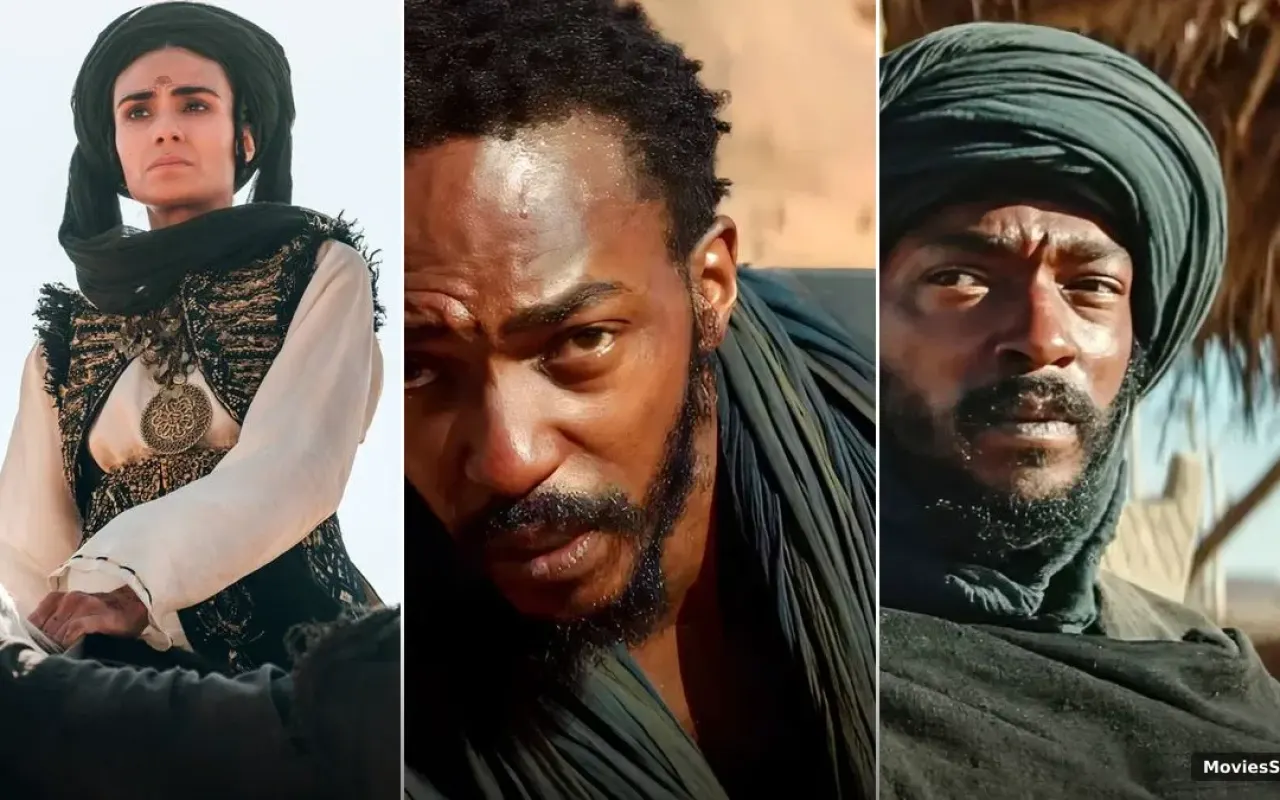
After nearly five years of production delays, creative overhauls, and mounting industry anticipation, the historical action epic Desert Warrior has finally arrived in theaters. This Desert Warrior movie review examines whether the $150 million investment—the largest ever for a film produced in Saudi Arabia—has yielded a cinematic masterpiece or a cautionary tale of over-ambition. Starring Anthony Mackie and Aiysha Hart, the film attempts to blend Hollywood blockbuster sensibilities with the rich, pre-Islamic history of the Arabian Peninsula.
What is the movie Desert Warrior about?
Desert Warrior is a $150 million historical action epic directed by Rupert Wyatt, starring Anthony Mackie and Aiysha Hart. Set in 7th-century pre-Islamic Arabia, the film follows Princess Hind as she unites Arab tribes against the Sassanid Emperor Kisra (Ben Kingsley), culminating in the historic Battle of Dhi Qar.
Desert Warrior Plot: A 7th-Century Struggle for Freedom
The narrative is anchored in the twilight of the Sassanid Empire. The story begins with Emperor Kisra (portrayed with a cold, detached menace by Ben Kingsley) issuing a decree that violates ancient tribal codes: he demands the daughters of all vassal kings to serve as his concubines. When King Al-Numan III of the Lakhmid Kingdom refuses to surrender his daughter, Princess Hind (Aiysha Hart), he sets off a chain reaction of defiance that threatens the very foundations of Persian hegemony.
As they flee across the treacherous Tabuk Province, the royals encounter "The Bandit" (Anthony Mackie), a nameless drifter with a mysterious past and a Captain America star's level of combat prowess. While the Bandit is initially motivated by the promise of gold, he eventually becomes the tactical architect of Hind’s resistance. The film shifts from a Western-inspired chase sequence into a grand-scale military drama as Aiysha Hart’s Princess Hind evolves from a fugitive into a queen capable of uniting disparate tribes under a single banner of Arab identity.
Critical Consensus: Why Critics and Audiences are Divided
The Anthony Mackie Desert Warrior Rotten Tomatoes score reveals a significant rift between professional critics and general audiences. Currently, the film sits at a "rotten" 31% among critics, while the audience score remains notably higher at 62%. This disparity highlights the film’s fundamental identity crisis: it is a visual marvel that often lacks narrative depth.
- The Visual Triumph: Critics and audiences alike have praised the work of cinematographer Guillermo Garza. The film utilizes the natural, imposing rock formations of the NEOM production hub to create a sense of scale that CGI simply cannot replicate.
- The Scripting Struggles: The primary criticism involves the screenplay by Rupert Wyatt, Erica Beeney, and David Self. Many reviewers found the dialogue to be a jarring mix of archaic solemnity and modern colloquialisms, such as characters shouting "Let’s go!" during 7th-century skirmishes.
- Performance Disparities: While Aiysha Hart has been lauded for her emotional range as Princess Hind, Anthony Mackie has faced criticism for a "lackluster" performance and a distracting, inconsistent accent that fails to ground his character in the setting.
The Real History: Was the Battle of Dhi Qar Real?
One of the most significant content gaps in current coverage is the actual Battle of Dhi Qar movie accuracy. The film is based on a pivotal historical event that took place around 609 AD. In historical texts, the Battle of Dhi Qar (or Dhu Qar) is celebrated as the first time Arab tribes decisively defeated a professional Persian Sassanid army.
The historical significance of the Battle of Dhi Qar cannot be overstated; it shattered the myth of Sassanid invincibility and is often cited by early Islamic historians as a precursor to the Arab conquests that followed shortly after. The real Princess Hind bint al-Nu'man was indeed a figure of immense cultural weight, known for her intelligence and her role in preserving her father's legacy after his execution by Emperor Kisra (Khosrow II).
While the film introduces Anthony Mackie’s character as a fictional catalyst, the core conflict—the refusal of King Numan to hand over his daughter and the subsequent tribal coalition led by the Banu Shayban—is rooted in genuine Arabian lore. The depiction of the Sassanid Empire as a decadent, overextended superpower also aligns with the geopolitical realities of the era, as the empire was exhausted by decades of war with Byzantium.
Desert Warrior Box Office Flop: The $150M Financial Fallout
Despite its grand ambitions, the Desert Warrior box office flop has become a major talking point in the industry. Opening to a dismal $472,000 in its first weekend, the film failed to crack the top ten, losing out to holdovers like Project Hail Mary. For a film with a Desert Warrior Saudi Arabia budget of $150 million, these numbers are catastrophic.
Several factors contributed to this failure:
- The 5-Year Delay: Filming began in September 2021 and concluded in February 2022. The four-year post-production struggle, reportedly due to "creative differences" between Wyatt and MBC Studios, sapped the film’s momentum and made it feel like "old news" by its 2026 release.
- Marketing Vacuum: Vertical Entertainment opted for a limited theatrical release with minimal promotional spending, suggesting a lack of confidence in the final cut.
- Competition: The film was released in a crowded window alongside high-concept sci-fi and established franchise sequels, making it difficult for a standalone historical epic to find an audience.
Behind the Scenes: Where Did the $150 Million Go?
To understand the Desert Warrior Saudi Arabia budget, one must look at the technical scale of the production. Unlike many modern epics that rely on green screens, Rupert Wyatt insisted on practical tactility. The production employed over 4,500 extras for the climactic battle scenes and utilized hundreds of live camels and horses, significantly driving up daily operating costs.
Furthermore, the film served as a massive "on-the-job" training program. As part of Saudi Arabia's film industry growth initiative, the production trained over 300 local Saudi crew members in specialized departments like stunt coordination, practical effects, and art direction. While this investment benefits the long-term infrastructure of the NEOM production hub, it added a "development tax" to the film's bottom line that a standard Hollywood production wouldn't carry.
Geopolitical Implications: NEOM and Saudi Film Ambition
Desert Warrior is more than just a movie; it is a flagship project for MBC Studios and the broader Vision 2030 framework. By financing a historical action epic of this magnitude, the Saudi government aimed to prove that the Tabuk Province could compete with established filming hubs like Morocco or Jordan.
However, the project has not been without controversy. The filming location in NEOM is part of a multi-billion dollar development project that has faced international scrutiny regarding land displacement and worker rights. Critics have argued that the film acts as a "gorgeous two-hour commercial" for a region undergoing radical, and sometimes forced, transformation. When compared to other Saudi-funded projects like Kandahar (starring Gerard Butler), Desert Warrior represents a much larger, albeit riskier, attempt to control the narrative of Arabian history through a Western lens.
Director’s Cut and Future Prospects
Rumors have circulated regarding a potential "Director’s Cut" by Rupert Wyatt. Reports of multiple re-edits during the 2023-2025 period suggest that the theatrical version may have been "flattened" by studio interference. A longer, more nuanced cut could potentially address the character development gaps that critics have highlighted, particularly the underwritten relationship between the Bandit and Princess Hind.
For Anthony Mackie, the film’s failure is unlikely to derail his career trajectory as he remains a cornerstone of the MCU, but it does raise questions about his "bankability" outside of the superhero genre. Conversely, Aiysha Hart emerges as the film’s true winner, proving she can carry a massive production with grace and intensity.
Key Takeaways: The Legacy of Desert Warrior
- Financial Disaster: With a $150M budget and a sub-$1M opening, the film is one of the biggest financial disappointments of 2026.
- Historical Value: Despite narrative flaws, the film successfully brings the Battle of Dhi Qar to a global audience, highlighting a crucial moment in pre-Islamic history.
- Visual Masterpiece: The practical effects and cinematography of the Tabuk Province are world-class, setting a new bar for regional productions.
- Production Hub: The film successfully established NEOM as a viable, high-capacity production hub, despite the film's own commercial failure.
- Cast Performance: Aiysha Hart delivers a career-defining performance, while Ben Kingsley and Sharlto Copley provide reliable, if underutilized, supporting turns.
Conclusion: A Beautiful but Hollow Monument
Ultimately, Desert Warrior is a film caught between two worlds. It wants to be a gritty, Lawrence of Arabia-style epic, yet it often falls into the traps of generic blockbuster filmmaking. While it fails to deliver a cohesive or emotionally resonant story, its existence marks a turning point for Middle Eastern cinema. The Desert Warrior movie review verdict is clear: it is a visual spectacle worth seeing on the largest screen possible, even if the story behind the camera is more compelling than the one on it. As Saudi Arabia continues to invest in its cinematic future, Desert Warrior will likely be remembered as the expensive, beautiful, and flawed foundation upon which an entire industry was built.