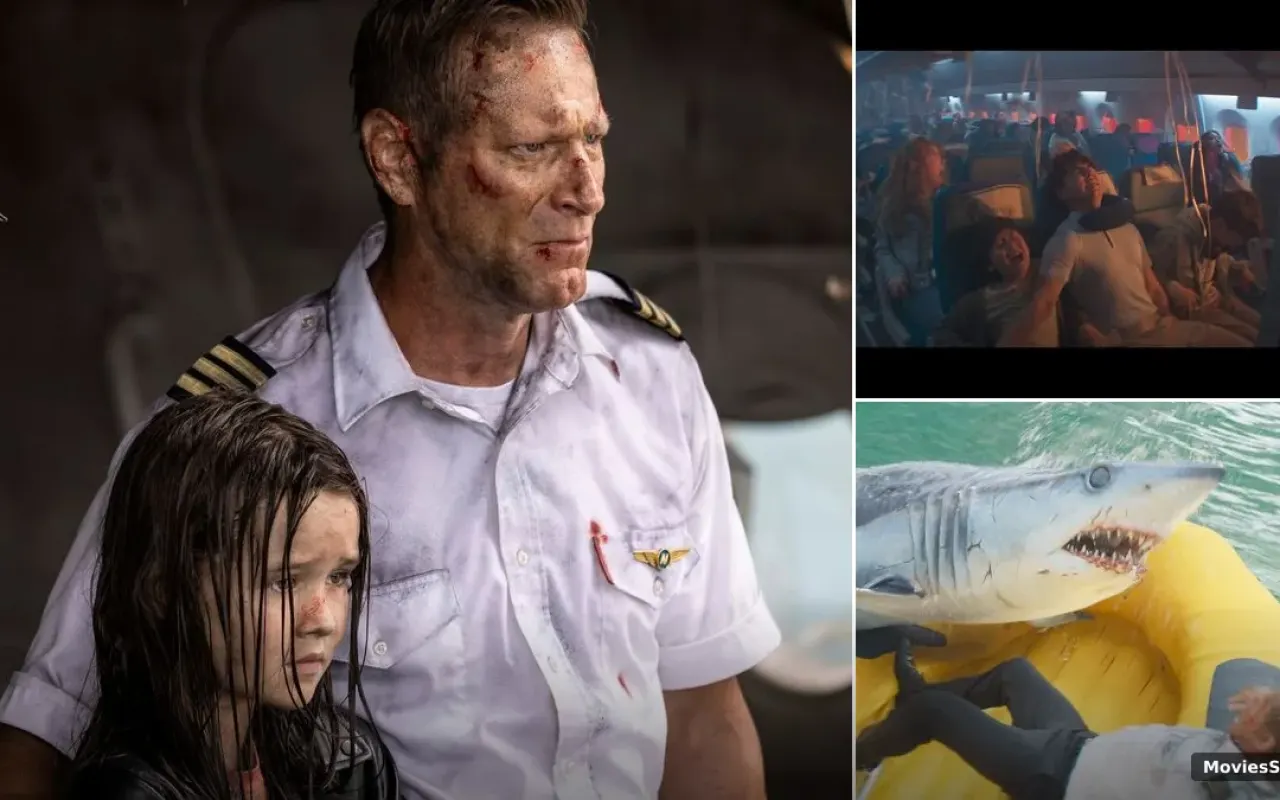
Renny Harlin, the director who famously redefined the aquatic horror genre with 1999’s Deep Blue Sea, has returned to the ocean with a vengeance. In his latest survival thriller, Deep Water (2026), Harlin attempts to marry the claustrophobic terror of an airplane disaster movie with the primal fear of shark-infested waters. The result is a visceral, high-stakes B-movie spectacle that feels like a throwback to the disaster epics of the 1970s, albeit updated with a glossy, digital-heavy finish. This Deep Water 2026 review explores whether this genre mashup sinks or swims under the weight of its ambitious premise.
What is the movie Deep Water 2026 about?
Deep Water (2026) is a survival thriller directed by Renny Harlin where a flight from LA to Shanghai crashes in the Pacific, forcing survivors to battle man-eating sharks. The narrative follows First Officer Ben (Aaron Eckhart) as he leads a fractured group of survivors trapped on the floating wreckage of a 747 in the middle of the ocean.
The Premise: A Double Disaster in the Pacific
The Deep Water movie plot wastes little time on pleasantries. We are introduced to a flight path from Los Angeles to Shanghai, populated by a demographic cross-section of passengers that seems almost mathematically designed for maximum carnage. The first act centers on a harrowing Pacific Ocean crash triggered by a seemingly minor suitcase fire in the cargo hold. This sequence is Harlin at his most kinetic; the cabin transforms into a depressurized "tin can," turning carry-on luggage and interior paneling into lethal shrapnel.
Unlike many survival thrillers that focus on the crash itself, Deep Water treats the aviation failure as merely the appetizer. Once the aircraft is severed into three floating sections across the water, the true horror begins. The transition from an emergency landing to an open-water feeding frenzy is handled with a "strikingly linear brutality," as the survivors realize they are no longer at the top of the food chain. The film effectively captures the isolation of the deep blue sea, where the wreckage of a modern marvel becomes nothing more than a dinner plate for the predators below.
The Deep Water 2026 Cast: Heroes and Shark Food
The Deep Water 2026 cast is anchored by two heavyweights who lend a sense of gravity to an otherwise "shlocky" script. Aaron Eckhart, who previously played a co-pilot in the grounded realism of Sully, steps back into the cockpit as First Officer Ben. Eckhart brings a "Big Daddy" energy to the role—a stoic, 20th-century American dignity that serves as the film's emotional life raft. His character is motivated by a sick child back home, a classic trope that Eckhart manages to sell through sheer grit.
Opposite him is the legendary Ben Kingsley, playing Captain Rich. While Kingsley’s role is relatively brief, his presence as the veteran pilot provides a necessary counterpoint to the chaos. The supporting cast is a collection of archetypes often found in "Final Destination" style narratives:
- Angus Sampson: Playing the "obnoxious jerk" whom the audience is practically invited to root against.
- Molly Belle Wright: A young girl navigating family trauma amidst the disaster.
- Li Wenhan and Lakota Johnson: Representing a Chinese e-sports team caught in a naive romance subplot.
- Kate Fitzpatrick: A sassy, iPad-addicted grandmother who provides moments of levity.
Renny Harlin’s Return to Shark-Infested Waters
For fans of the Deep Blue Sea director, this film is a fascinating study in genre evolution. Harlin, now 67, has spent decades navigating the highs of Cliffhanger and Die Hard 2 and the lows of more recent, less-seen endeavors. Deep Water feels like a homecoming. It lacks the "physical weight" of the practical effects used in 1999, opting instead for a "clean digital sheen" provided by Magenta Light Studios.
The Renny Harlin shark movie legacy is built on a "winkingly acknowledge pulp pedigree." While Deep Water takes its monster-movie elements more seriously than the meme-ified Sharknado, it doesn't quite reach the philosophical heights of Jaws. Instead, it occupies a middle ground—a B-movie spectacle that relies on "elite-level mastery of CGI" and "nifty practical effects" to keep the audience engaged. The editor, Geoff Lamb, who recently gained acclaim for Talk to Me, ensures the pacing remains relentless, crosscutting between the three sections of the wreckage to prevent any "thumb-twiddling."
Behind the Scenes: Production, Budget, and Technical Specs
One of the most intriguing aspects of the film is its production pedigree. Gene Simmons producer credits are rare in the horror-thriller space, but the KISS frontman’s Magenta Light Studios has backed this mid-budget venture with significant resources. Filming took place across diverse locations, including the Canary Islands, Rome, and New Zealand, utilizing the Canary Islands Film Commission's incentives to create a vast, oceanic feel.
Technical Specifications and Realism
From a technical standpoint, the film utilizes a wide aspect ratio to emphasize the horizon's emptiness. While the Deep Water 2026 budget is estimated to be in the $30-40 million range, the VFX supervisor has integrated the CGI sharks—primarily Great Whites and Tiger sharks—with a focus on "visceral lighting" rather than pure anatomical realism.
A "realism check" by aviation experts might find the cockpit scenes wanting, despite Aaron Eckhart undergoing pilot training for the role. However, the film prioritizes "kinetic pleasure" over technical accuracy. The sequence involving the "Mile High Club" couple leaving their infants behind is a testament to the script’s commitment to "meaningless brutality" over logical human behavior.
The Script: Six Writers and a Sea of Clichés
The Deep Water 2026 release date was preceded by a complex development cycle involving six credited screenwriters, including Pete Bridges and Damien Power. This "writing by committee" approach is evident in the dialogue, where every line seems to foreshadow a character's eventual demise. The script evolution suggests a project that may have spent years in "development hell," being polished into a shape that hits every necessary beat of a summer programmer without necessarily adding anything new to the subgenre.
The "Who Dies?" Factor
In the tradition of disaster cinema, the film treats its ensemble as a "walking buffet." The Deep Water 2026 shark species are depicted as relentless, calculated killers. While we won't spoil the final body count, it is safe to say that the "asshole" archetype meets a particularly satisfying end, and the "Chinese e-sports team" subplot concludes with a tragic, if predictable, twist that highlights the film's "Final Destination" sensibilities.
Key Takeaways: Deep Water (2026)
- Director Pedigree: Renny Harlin returns to the shark genre for the first time since Deep Blue Sea.
- Lead Performances: Aaron Eckhart and Ben Kingsley provide much-needed gravitas to a trope-heavy script.
- Production: Produced by Gene Simmons via Magenta Light Studios; filmed in the Canary Islands and New Zealand.
- The Sharks: Features a mix of Great White and Tiger sharks, utilizing a blend of practical and digital effects.
- Tone: A high-octane survival thriller that prioritizes jump scares and pulse-pounding action over deep character development.
Conclusion: Is Deep Water 2026 Worth Watching?
As we look toward the future of the franchise, many are already asking: is Deep Water 2026 a sequel to Deep Blue Sea? While it is not a direct narrative sequel, it serves as a spiritual successor, capturing the same "man vs. nature" intensity that made Harlin a household name in the 90s. The film concludes with enough ambiguity to suggest a potential sequel, though its fate will likely depend on its performance on streaming on Netflix or Max following its theatrical run.
Ultimately, Deep Water is a "durable" and "serviceable" entry into the shark-thriller canon. It doesn't reinvent the wheel, but it spins it with enough "gusto" to satisfy fans of the genre. If you're looking for a "wild ride" that combines the terror of a plane crash with the primal dread of the deep, Harlin’s latest is a flight worth taking—just don't expect to see it on any in-flight entertainment lists anytime soon.