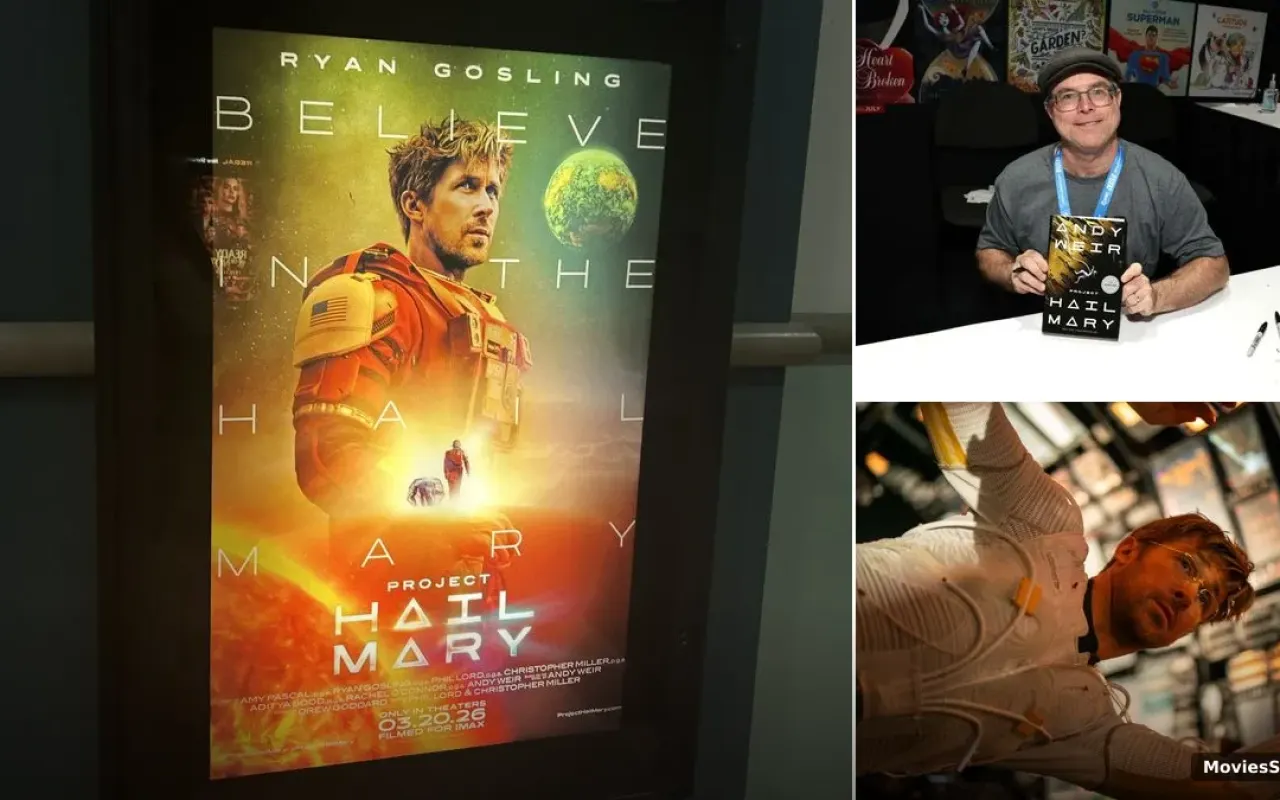
Real talk: sci-fi fans have been burned before. We’ve all seen the "unfilmable" book get turned into a CGI slurry that loses the soul of the source material. But the Project Hail Mary movie has managed to do the impossible. It didn’t just survive the jump from Andy Weir’s best-selling pages to the big screen; it’s currently obliterating the box office and setting a new gold standard for hard science fiction. Whether you’re here for the "Amaze" memes or a deep dive into the engineering of the Blip-A, this is the only breakdown you need.
What is Project Hail Mary movie about? Project Hail Mary is a 2026 sci-fi film directed by Phil Lord and Christopher Miller, starring Ryan Gosling as Ryland Grace. Based on Andy Weir's novel, it follows a lone astronaut who teams up with an alien engineer named Rocky to save Earth from a sun-dimming microorganism called Astrophage.
A New Sci-Fi Masterpiece: Project Hail Mary's Box Office Dominance
The Project Hail Mary box office run is, quite frankly, astronomical. In less than a month since its March 20, 2026, release, the film has officially surpassed Disney’s The Incredibles at the domestic box office, raking in $264.6 million. For context, it’s also outpaced Mission: Impossible – Dead Reckoning, hitting milestones in five weeks that took Tom Cruise’s epic ten weeks to achieve.
With a worldwide total projected to soar past $700 million, the film is currently nipping at the heels of The Martian comparison ($630M). The wild part? It’s maintaining this momentum despite a massive 156-minute runtime. Audiences aren't just showing up for the Ryan Gosling Ryland Grace performance; they’re staying for the "extended" theatrical cut that Phil Lord and Christopher Miller insisted on to keep the science intact.
The international breakdown shows a massive appetite for smart sci-fi, with China and the UK leading the charge. This isn't just a win for Amazon MGM Studios; it’s a signal that the "smart blockbuster" isn't dead. While other franchises are leaning on nostalgia, Project Hail Mary is winning on pure, original vibes and Certified Fresh Rotten Tomatoes energy.
Bringing Rocky to Life: Practical Puppetry vs. CGI
The biggest question everyone had before the trailer dropped: How are they going to do Rocky? We’re talking about a five-legged, stone-skinned, faceless alien who communicates through musical chords. The Rocky Project Hail Mary design could have easily been a CGI disaster, but the production took a radical "practical-first" approach.
Instead of a guy in a green leotard, the crew used 3D printed spaceship sets and physical spider-like puppets operated by a team of world-class puppeteers. James Ortiz, the movement mastermind, led the performance. To simulate the Eridian "clock-speed"—the fact that Rocky moves much faster than a human—the production team used a mix of high-frame-rate filming and physical rigs that allowed the puppet to move with terrifying, fluid precision.
- Practical vs. CGI: Roughly 70% of Rocky’s screen time involves a physical model, with CGI used primarily to smooth out the joints and handle the high-speed "scuttling" sequences.
- The Set: The interior of the Hail Mary was built as a multi-story, 360-degree set based on International Space Station ISS engineering references. There were almost no blue screens; if Grace was looking out a portal, he was looking at high-res LED screens.
- Zero-gravity practical effects: To avoid the "floaty" look of bad CGI, Greig Fraser (cinematography) used a sophisticated wire rig system that allowed Gosling to move realistically in a 3D space, mimicking the physics of Tau Ceti.
The Linguistics of Rocky: Eridian Language Translation
The Eridian language translation is one of the film's most underrated triumphs. In the book, Rocky speaks in musical notes. To translate this to film, the Daniel Pemberton score actually incorporates Rocky’s voice into the soundtrack. The production team worked with linguists to create a "musical syntax." If you listen closely, Rocky’s "speech" follows consistent tonal rules. The film even uses specific songs by The Beatles and Harry Styles during montage sequences to bridge the cultural gap between Grace and his alien bestie.
Movie vs. Book: Why the Antarctica Nuclear Scene Was Cut
Even the best Andy Weir movie adaptation has to make cuts. During a recent interview, Weir admitted his "one regret" was the loss of the Antarctica nuclear sequence. In the novel, Earth’s scientists decide to nuke the Antarctic ice shelf to trigger a massive methane release, hoping to create a greenhouse effect to counter the Astrophage-induced cooling.
Why was it cut? Drew Goddard (screenwriter) and the directors argued that the scene, while epic, pushed the runtime past the breaking point and distracted from the core mission in space. Instead, the film focuses on the global "Petrova Line" crisis through the eyes of Sandra Hüller Eva Stratt, who delivers a chilling performance as the woman given absolute power to save the world.
Project Hail Mary Ending Explained: Book vs. Screen
The Project Hail Mary ending explained usually centers on one major shift: the emotional payoff. While the book ends with a somewhat clinical (though heart-tugging) look at Grace teaching Eridian children, the movie leans harder into the "growth film" arc. We see a more visual representation of a frozen Earth and a more definitive look at the "Adrian" planet ecosystem. The film emphasizes that Grace didn't just save two worlds; he found a purpose he never had as a middle school teacher on Earth.
The Science of Astrophage and Tau Ceti
For the nerds (we say that with love), the Project Hail Mary science accuracy is surprisingly high. The film treats Astrophage not as a "space monster" but as a biological reality—a microorganism that converts light directly into mass.
- The Blip-A Design: Rocky's ship was designed with "Eridian engineering" in mind—no windows (because they use sonar) and a radiator-heavy hull to manage the intense heat of their home planet, Erid.
- The Centrifuge: The film painstakingly depicts the "tether" system used to create artificial gravity, a detail often ignored in lazier sci-fi.
- The Petrova Line: The visual of the sun’s "arc" of dimming was rendered using actual solar physics models to ensure the light levels looked "wrong" in a way that feels scientifically unsettling.
NASA scientists who reviewed the film noted that while "fueling a ship with light-eating bacteria" is speculative, the orbital mechanics and the depiction of Tau Ceti are remarkably grounded. The 3D-printed sets weren't just for show; they were engineered to look like a ship built by a committee of international space agencies, complete with ISS-style handrails and modular panels.
Key Takeaways
- Box Office King: The Project Hail Mary movie is a massive financial success, proving audiences want high-concept, original sci-fi.
- Practical Magic: Rocky is largely a physical puppet, not a CGI creation, giving the character a tangible, soulful presence.
- Faithful but Trimmed: The Antarctica nuclear blast was cut for pacing, but the core relationship between Grace and Rocky remains the heart of the story.
- Hard Science: From Eridian language translation to zero-G physics, the film respects the "hard science" roots of Andy Weir’s novel.
The Future: Is a Sequel Coming?
With the film's massive success, the Andy Weir Project Hail Mary sequel news is the hottest topic in Hollywood. While Weir hasn't written a second book yet, the film's ending leaves the door wide open. Whether we see a return to Earth or a further exploration of the Erid system, one thing is clear: the duo of Grace and Rocky has become the most iconic sci-fi pairing of the decade.
If you haven't seen it yet, do yourself a favor and catch it in IMAX vs Dolby Cinema—the sound design of Rocky’s musical voice alone is worth the premium ticket price. This isn't just a movie; it's the kind of "rousing, exciting blockbuster" that reminds us why we go to the theater in the first place. Amaze!